
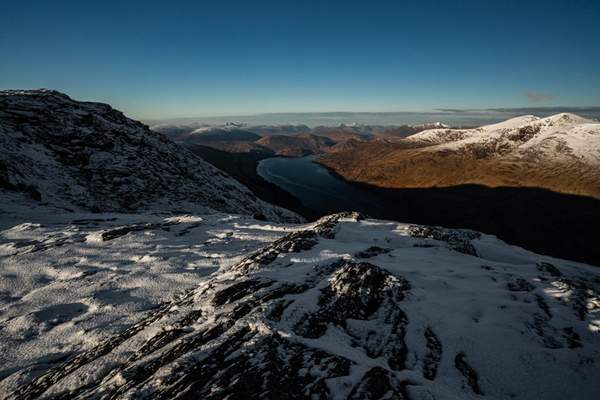
Winter hiking in Scotland changes the character of a familiar hill day. A route that feels straightforward in summer can become a serious undertaking when paths vanish under snow, daylight is scarce and the ground freezes hard. The rewards are remarkable: quiet glens, snowy ridges and crisp mountain views. But the best winter days begin with realistic choices, not a fixed determination to reach the summit.
For experienced walkers stepping into winter hillwalking, the essential question is whether the route, weather, snow conditions, equipment and group’s skills match on the day.
Choose a route you can change
A summer route grade is only a starting point. Snow can hide paths and drainage channels; hard ice can make a descent hazardous. Exposed ridges, steep traverses and corniced edges need particular care, while wind and low cloud can make modest hills demanding.
Prepare three options: a mountain objective for suitable conditions, a sheltered shorter hill and a low-level alternative. Changing plans is sound judgement, not failure.
For a first Scotland winter walking trip, a lower-level route near Aviemore may be more appropriate than immediately tackling the Cairngorm plateau. Its broad snow-covered terrain can become disorientating in a whiteout, especially near steep corrie edges.
Give daylight and walking pace more respect
Check sunrise and sunset for your exact area and date. Agree a turnaround time before leaving, allowing for clothing changes, navigation stops and slow progress through deep snow. A six-hour summer outing can take considerably longer in winter, although no single time multiplier fits every route.
Carry a reliable headtorch and spare power, but avoid making darkness part of the plan unless the whole group is prepared for night navigation. Tell someone your intended route, alternatives and expected return time.
Read weather and avalanche reports together
A forecast for a nearby town says little about exposed mountain tops. Check the Met Office mountain forecast or Mountain Weather Information Service for summit wind, freezing level, precipitation and visibility. Recheck before departure because conditions can shift overnight.
Where snow is present, consult the Scottish Avalanche Information Service for the relevant area during its forecasting season. Read the complete report, including affected slope aspects and elevations, rather than relying only on the hazard category. A lower category does not mean every slope is safe; a missing forecast outside the reporting season is not a safety guarantee.
Wind can move snow onto sheltered slopes, building unstable deposits. The surface can also change abruptly from soft drifts to ice-hard snow. Avoiding hazardous terrain is more reliable than expecting equipment to solve every problem.
Scottish winter hiking gear that earns its place
Winter mountain hiking requires more than packing an extra jumper. Choose clothing that manages moisture and protects you while moving, then keeps you warm when stationary.
Layers and safety essentials
Wear a base layer, insulating mid-layer and waterproof, windproof shell. Add spare gloves, a warm hat, waterproof trousers and an extra insulating layer for stops. Keep dry items protected inside your rucksack.
Carry a paper map and compass, offline mapping on a charged phone, headtorch with backup power, first-aid supplies, emergency shelter, whistle, food and drinks. A flask of something hot helps on a long day. Goggles or sunglasses can protect against blowing snow and glare.
Winter boots, crampons and ice axe
Steep frozen terrain may require suitably stiff winter boots, compatible crampons and an ice axe, together with the skills to use them. Check compatibility before buying or hiring. Flexible summer boots and lightweight traction aids do not replace proper crampons on consequential steep snow or ice.
Do not assume carrying an axe makes a route safe. If conditions demand techniques you have not learned, choose easier ground or seek instruction.
Practise navigation before visibility disappears
Snow can erase tracks and cairns, while flat light disguises the shape of a slope. GPS is a helpful cross-check, but batteries can run low and screens become awkward with cold fingers. Learn to navigate using a map, compass, bearings, distance and identifiable terrain features.
Before setting out, mark safe descent options and places where drifting off course could lead towards crags or cornices. In a whiteout, stop and confirm your location rather than following an assumed trail.
Further reading on mountain navigation skills and cold-weather layering can help you prepare for specific weaknesses before your next trip.
Build the winter skills the route demands
Summer hillwalking experience is valuable, but does not automatically cover ice axe use, efficient crampon movement, winter navigation or avalanche awareness. A course led by a qualified winter mountain professional provides supervised practice and improves decision-making.
Mountaineering Scotland offers winter skills training. Learning an ice axe arrest is worthwhile, but it cannot guarantee that a real fall will stop. Preventing slips through route choice and careful movement matters more.
How a good plan changes in Glen Coe
Imagine arriving for a winter ascent above Glen Coe. The glen is calm, but the mountain forecast predicts strong ridge winds and low cloud. The avalanche report identifies windslab on slopes similar to those on your planned line.
Rather than walking higher to see how things develop, take your preselected lower-level route. You still enjoy the landscape without making difficult decisions after entering exposed terrain. That flexibility is a vital winter hillwalking skill.
Know when to turn around and call for help
Turn back if weather, ground conditions, visibility or fatigue exceed your plan. Keep the group together and carry enough shelter and insulation to manage an unexpected wait.
In a Scottish mountain emergency, call 999 or 112, ask for Police and then Mountain Rescue. Give a grid reference or clear location, the number of casualties and relevant details. Mobile reception can be unreliable; emergency SMS registration must be completed beforehand if you intend to use that service.
Frequently asked questions
Can experienced summer walkers go hiking in Scotland in winter?
Yes, on routes that match their abilities and the conditions. Snowy mountain terrain may demand training, winter equipment and avalanche awareness beyond ordinary summer walking skills.
Are crampons needed on every winter walk?
No. The need depends on the surface, steepness and consequences of a slip, not the calendar. Hard snow and ice on steep mountains can make compatible crampons essential.
When should I check avalanche information?
Check the relevant Scottish Avalanche Information Service report while planning and review the latest information before departure when forecasts are operating. Continue observing conditions throughout the day.
What is the best way to gain winter confidence?
Start with manageable walks, join competent companions and take a winter skills course before attempting exposed, snowy summits. Increase difficulty gradually.
Let the conditions decide the day
The appeal of winter hiking in Scotland lies in experiencing a transformed landscape, not forcing a summit at any cost. Keep alternative routes ready, allow generous daylight margins, assess weather and snow carefully, and carry equipment you know how to use. A well-judged descent can be as satisfying as a summit and leaves you ready for the next clear winter day.